Study finds deep gender gap across Bangladesh’s private sector
🔗 View Media Coverage on Dhaka Tribune
Speakers at the event stressed the need for stronger institutional commitments, equitable workplace policies, and long-term investment in women’s leadership and professional development to address systemic inequalities within the private sector.
A new study on workplace gender equity in Bangladesh’s private sector has revealed persistent structural inequalities in representation, pay, leadership opportunities, and workplace inclusion, underscoring the barriers women continue to face across industries despite growing participation in the workforce.
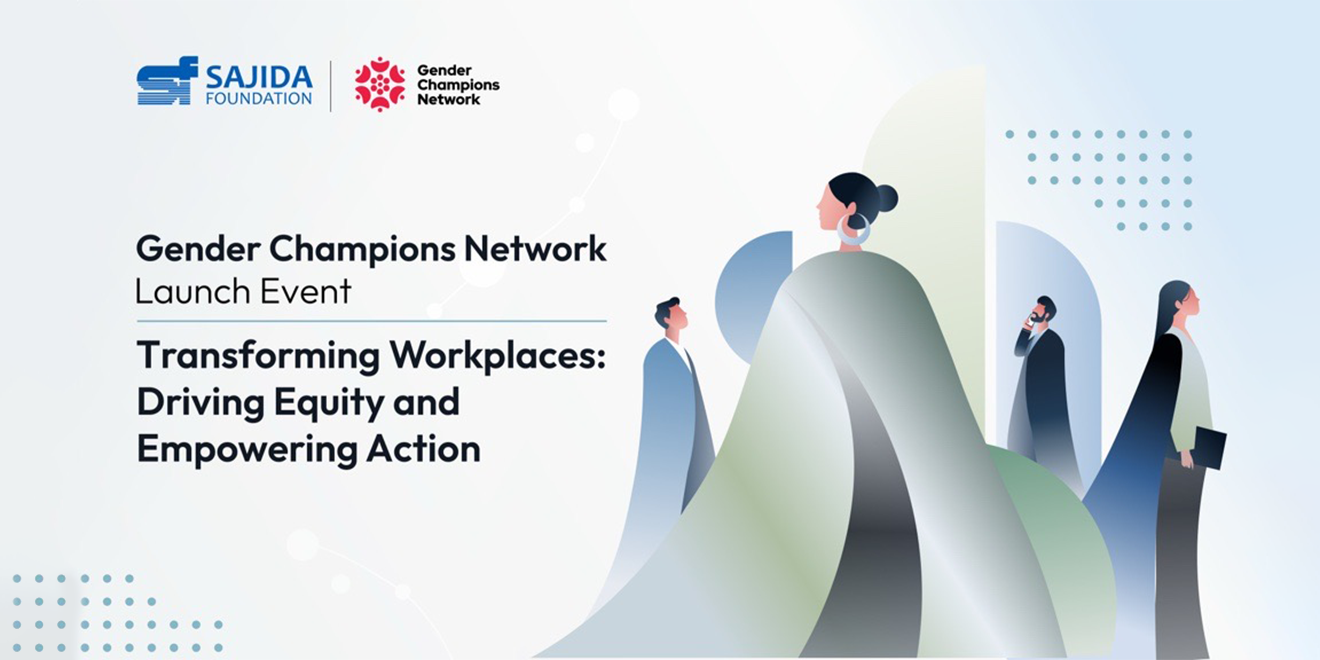
The findings were unveiled on Sunday at the launch of the Gender Champions Network (GCN), an initiative of SAJIDA Foundation supported by the Gates Foundation. The launch event, titled “Transforming Workplaces: Driving Equity and Empowering Action,” was held at Hotel Sheraton in Banani.
The research, titled “Gender at Work: A Study of Selected Private Sector Firms in Bangladesh,” examined gender equity practices across multiple sectors including manufacturing, healthcare, finance, pharmaceuticals, real estate, and leather.
Conducted using a mixed-method and multi-perspective approach, the study assessed workplace environments through six critical dimensions: gender representation, pay equity, recruitment and promotion practices, career advancement and mentorship opportunities, workplace culture and protections, and access to sexual and reproductive health and rights (SRHR) services.
The report paints a concerning picture of women’s progression within corporate structures. Although women constitute 22% of entry-level positions, their representation drops sharply to only 6% at the mid-management level.
Researchers noted that nearly three-quarters of female representation is lost during the first major career transition, reflecting systemic obstacles to retention and advancement.
Significant wage disparities were also highlighted in the study. According to the findings, women earn only Tk 85 for every Tk 100 earned by men in comparable roles. The inequality becomes even more severe at senior leadership levels, where the gender pay gap exceeds 40%.
Researchers further found that women continue to face unequal access to technical training, leadership development programmes, and professional mentorship opportunities, limiting their ability to move into decision-making positions within organizations.
Beyond workplace barriers, the study emphasized the disproportionate burden of unpaid care work carried by women. When household and caregiving responsibilities are taken into account, women were found to shoulder a substantially heavier total workload than men, affecting both their career progression and work-life balance.